Ben Carlsen's blog post has interesting statistics on average S&P decline for recessionary bear market (-39.4%) and non-recessionary bear market (-26.1%).
Now S&P is just entering bear market territory.
Ben Carlsen's blog post has interesting statistics on average S&P decline for recessionary bear market (-39.4%) and non-recessionary bear market (-26.1%).
Now S&P is just entering bear market territory.
[First post on 21 May 2022, updated on 17 Jun 2022]
Plan for purchase during downturn
Where is the investment clock/cycle now?
China/HK -- 5-7 o'clock
US -- 2-3 o'clock
Singapore -- 10-11 o'clock
Balancing and Prediction
Nobody knows where the market is going next. On hindsight, everyhing is obvious. But when you look ahead, everything is foggy.
Regular balancing between different asset is the counter to market unpredictability / market risks. Balancing is also the counter to cyclical behaviour i.e. the tendency to buy stocks at higher prices during bull market and the tendancy to sell stocks during bear markets.
Returns
My individual stock portfolio is down 11.7% YTD. The losses are mainly due to HK stocks like Tencent.
The individual stock portfolio is 45% of my total wealth. My total wealth also have other asset like CPF, cash, bonds (mainly SSB) and index fund/ETF. YTD, my total wealth is down 3%, as the stock losses are alleviated by my income.
A Mistake to Buy Asia High Yield Bond
I bought a smallish amount in Asia High Yield Bond ETF. After I bought it, it went 10% under-water. It is a mistake to buy it, as high yield bonds have high correlation with stocks and I have large allocation to stocks.
SSB Step-Buying
As interest rates are increasing, leading to SSB interest rates rising higher each month, I will buy some SSB each month and redeem the SSB (with much lower interest rates) bought last 2 years.
Gold Buying
I have been slowing accumulating Gold ETF (GLD). In the past, I would not think of buying gold, as it has no interest and does not produce anything. Now, I change my thinking, as gold can be a hedge against inflation and is a good diversifier (as it has low correlation with bond/stocks.) Moving forward, I should aim to have 5% of my total wealth in gold.
My View -- Cash may be the safest asset now
Cash (and CPF) may be the safest asset in the current environment of rising interest rate and high inflation. While the high inflation will erode the real value of cash, bonds/stocks are affected by rising interest rates. Commodities may be a good asset in current environment but I am not familar with commodities and commodities have large run-up in price this year.
Other Thoughts
Recently, I have been thinking of shifting my asset allocation to something closer to 'Permanent Portfolio' (=25% each in stock/bond/cash/gold) or 'All Weather Portfolio'. While such portfolio could have lower returns compared to 60/40 portfolio, it has lower volatility/drawdown and provides greater peace of mind.
I am also increasingly of the view that I am better off with investing in world stock etf like VWRA. Maybe I will reduce the size of my individual stock portfolio and allocate more funds to index fund/etf.
On Individual Stock Portfolio
Currently, I have some Singapore stocks purchase in 2020 or
early 2021, hoping that their prices will rise as we exit Covid. In 2022, if
these stocks’ prices rises as we exit Covid hopefully, I will sell them off.
In addition, I hope to continue to search for stocks with
quality business and will create a watchlist on them. If their prices are right, I
may initiate a position.
Eventually, I hope to own stocks whose earnings are
materially higher 10 years from now.
Others
As I have around 14% cash, I will put the cash to buy more
SSB in 2022. Probably I will buy some SSB each month in 2022 to average out the
yield. In addition, I may redeem a 2 SSBs that have low yields as they are
subscribed in mid 2021.
I may also put a portion of the cash into Endowus Smart
Enhanced to earn higher interest. In addition, I may sell some SRS stock
holdings and put them into Endowus Core Dimensional, which is a world equity
fund with low expense ratio, to get more diversification.
Thoughts on 2022
I think that interest rates around the developed countries
will rise in 2022, due to higher inflation in late 2021.
Cycle-wise, I feel that US equity market is quite expensive
relative to historical PE ratio and hence it should be near the top of the
cycle. For China stocks listed in HK, they seem to be in around the trough of
the cycle, as their stock prices have dropped a lot in 2021.
Singapore stocks should be around the average of the cycle, I guess.
I do not have views on other countries, as I am not familiar with them
This will be a review of my holdings this year.
1) Performance of Individual Stocks Portfolio
My stock portfolio rose 14.7% in 2021, over-performing STI ETF (13.2%). My return was as high as 23% in mid-June 2021, lifted by bullish sentiments in HK small caps. However, it was pulled down in 2H 2022 by China stocks listed in HK
Year | % Returns | STI ETF (incl Dividends) |
2019 | 8.4% | 9% |
2020 | 3.6% | -8.6% |
2021 | 14.7% | 13.2% |
Probably, I should not be comparing to STI ETF, as my portfolio has mainly shifted to non-Singapore stocks. (In 2020, Singapore stocks are still half of my portfolio.) I guess that I will stick to the comparison to STI, since I have been comparing to it for many years.
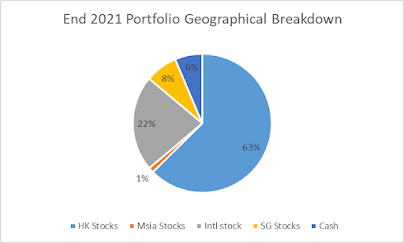

2) Position Sizing
Excluding odd lots, I have 19 open positions in my individual stock portfolio. Moving forward, I think my stock portfolio will have fewer than 19 position, as I prefer more concentration in stocks that are good businesses.
| Number of Stocks |
At end 2016 | 21 |
At end 2020 | 39 |
At end 2021 | 19 |
3) SRS, ETF (VWRA) and Non-Stock Portfolio
I have other stuff besides my individual stock portfolio. It comprise
· SRS account (mainly STI ETF and a few stocks which I don’t trade much)
· ETF (VWRA)
· Bonds – mainly Singapore Savings Bond (SSB) and Astrea IV-VI Bonds listed in SGX
· CPFB accounts
· Cash
4) Approx 60-40 Allocation
I have sticked to approx. 60% stock to 40% non-stock portfolio allocation.

I wanted to reduce my cash allocation to more bonds. However, I do not want to buy into bonds ETF in environment where interest rates are expected to rise in future. I will put more cash into SSB and money market account next year to earn higher interest rates.
5) Net Asset Growth
I started keeping track on my net asset since 2014. My net asset has been growing annually.
The 2021 increase in net asset is driven by stock portfolio returns and my wages this year.

Strategy Re-set
2021 is a year where I reset my investing strategy. I reset my strategy in 2012 to be more diversified. In 2021, I reset my strategy to buy quality business and own them for many years. This is still works-in-progress, as I still own 20 stocks currently.
My number of stocks owned should continue to decline over-time
Re-Thinking about Losses in Market
I used to fret a lot about losses. Now, I still fret but hopefully lesser, as I re-frame my thoughts. The re-framing is -- If I own a quality business that is growing annually, it does not matter if the business is priced lower or higher today. Because I am not looking to sell it.
If the business is priced much lower, with no detioriaration to its business quality, the market is offering me a chance to buy more at good price.
Cash/Equity Allocation Matters
I reviewed my allocation from 2014 onwards. My cash allocation were around 20% in 2014-17. If I had invested higher proportion of cash into equities, I will be richer now. Hence, I should strive to lower my cash proportion.
Currently, my cash proportion is still quite high at 14%. Hopefully, I can reduce them to 10% in 2022.
Owning Great Business for many years
I read Nick Sleep's letters recently. The key takeway is on owning great business for many years to let the compounding work. Another takeaway is owning business who are quality capital allocators.
Extract from the letters: "The biggest error an investor can make is the sale of a Walmart or a Microsoft in the early stages of the company’s growth. Mathematically, this error is far greater than the equivalent sum invested in a firm that goes bankrupt."
"The “super high-quality thinkers” are our best guess of those firms whose shareholders could abdicate their right to trade stock (allocate capital themselves) sure in the knowledge that their capital will be well allocated for years to come within the businesses. This list is a group of wonderful, honestly run compounding machines. We call this the “terminal portfolio”. This is where we want to go. The question is, why is this list not the same as the current Nomad portfolio?
This is not an easy question to answer. But let us return to the church analogy for a moment. When we think about companies, the over-riding analytical consideration is the quality of the business and quality of management’s capital allocation decisions. The longer investors own shares the more their outcome is linked to these two metrics."
